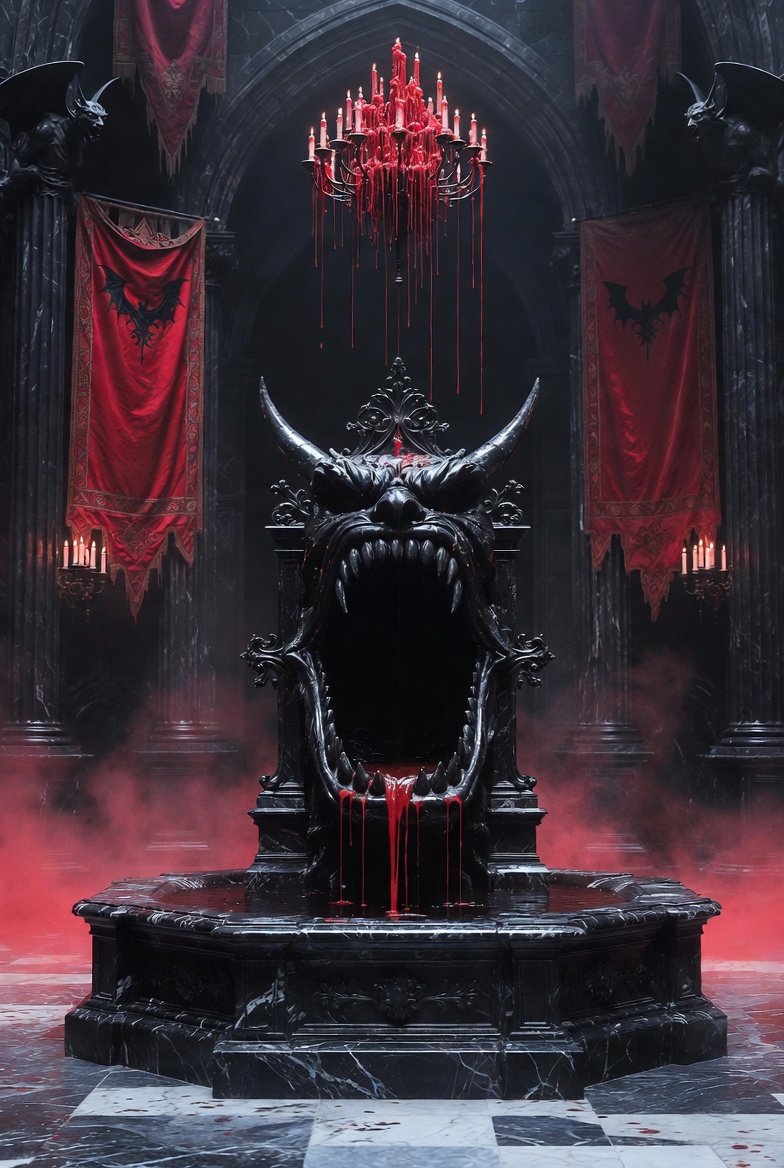
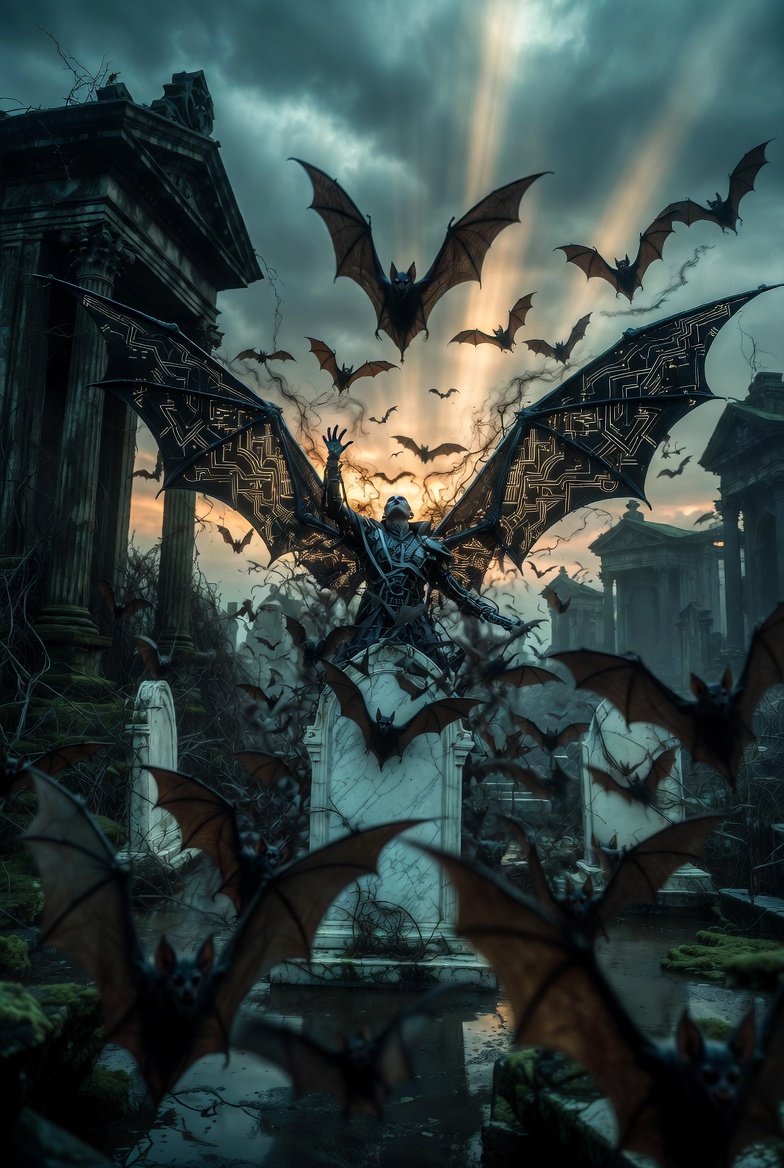
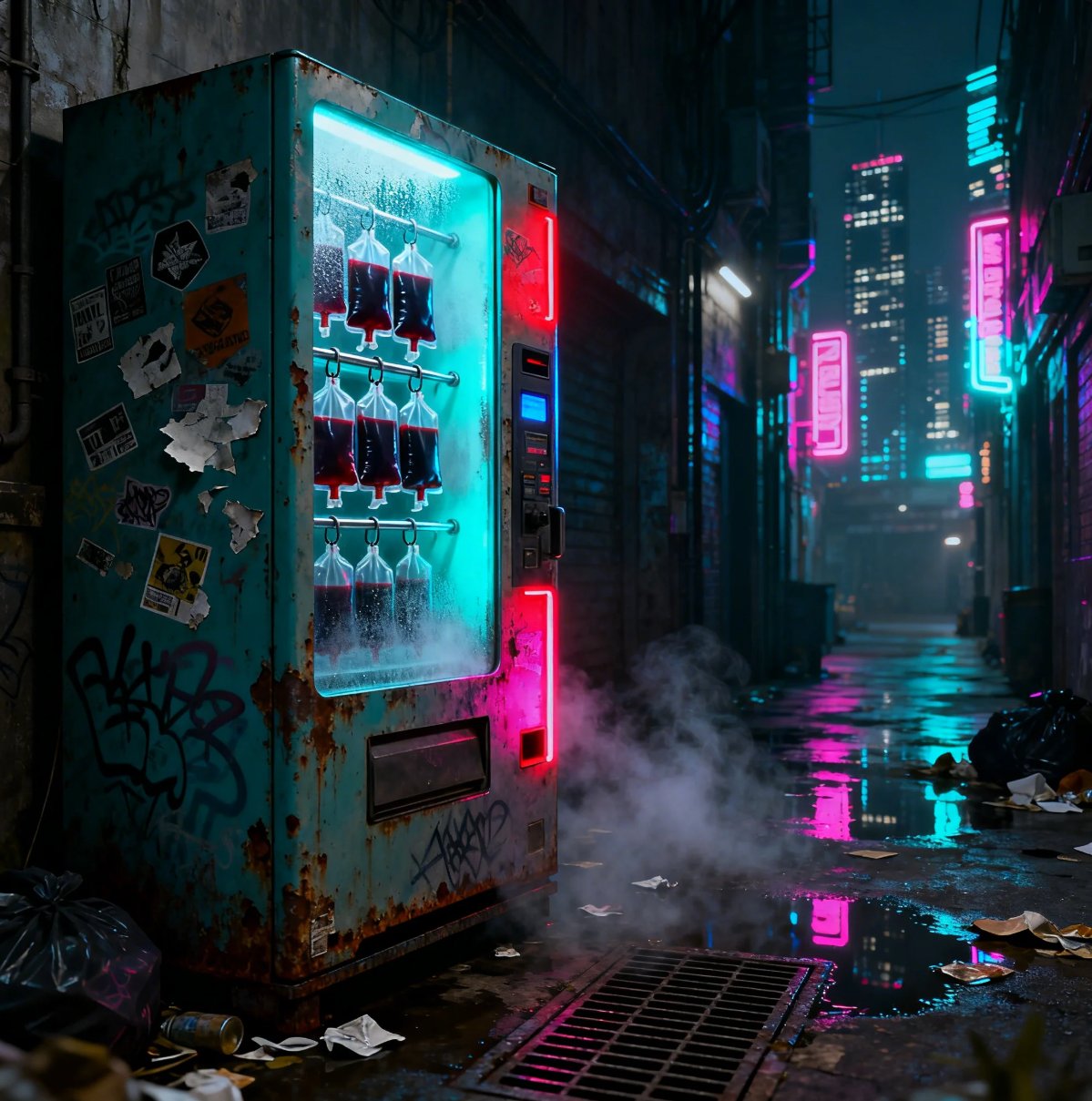
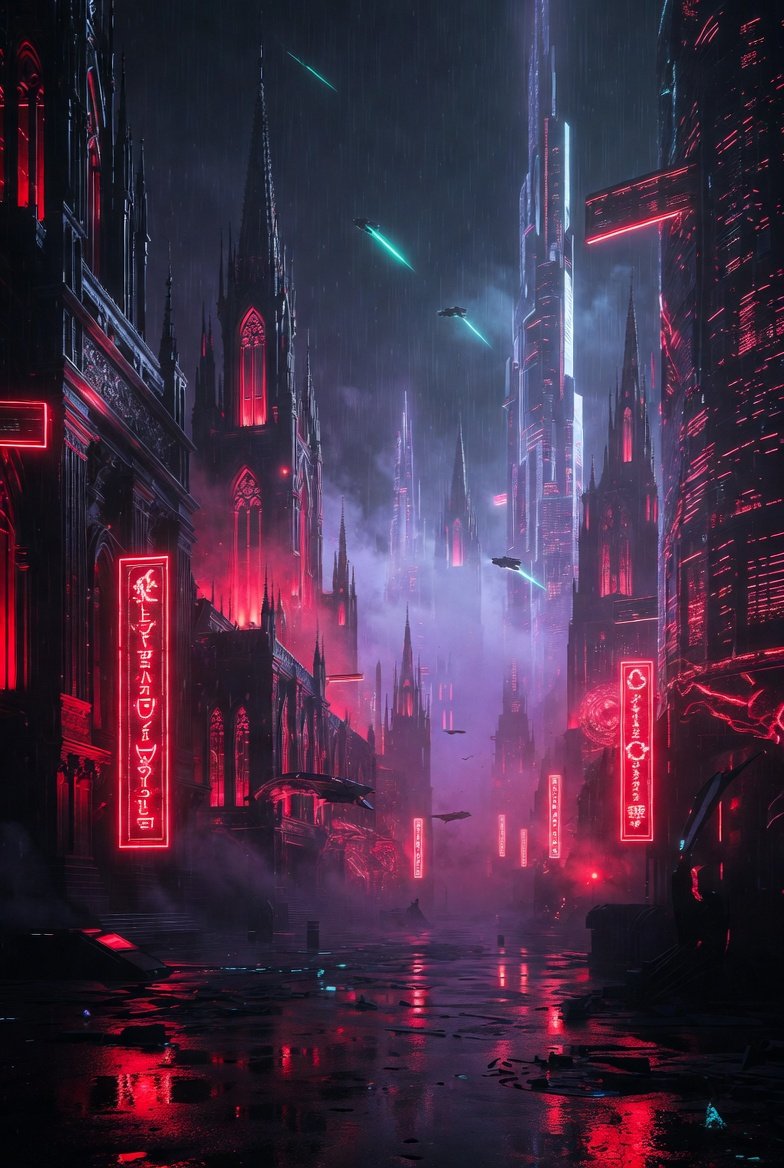
Ancient vampires. Quantum nanotechnology. A world remade in blood. You are an unseen Will — a force beyond knowing, guiding your faction through the eternal night of the Crimson Nexus. Four Sire Lords await your hand.
In the year 2147, the Eclipse War tore history in two. Ancient vampires — hidden for centuries — surfaced to clash with humanity's AI-driven empires in a global conflict that irradiated 90% of the world. When the smoke cleared, vampirism itself had evolved.
The traditional bite now carries a 90% mortality rate due to incompatible post-war genomes. In its place: synth-bite nanotech and quantum turning protocols — controlled by four factions vying for dominance of what remains.
Vampires are enhanced immortals sustained by vita-plasma — synthetic blood laced with data streams — and empowered by Technae: the radiant fusion of vampiric vitae and quantum nanotechnology. You, the player, are the unseen Will of the Nexus — an unknowable force felt only as surges of compulsion. None of them know what you truly are.

Technae is the shimmering crimson energy field that vampires naturally attune to post-turning — a fusion of vampiric vitae and quantum nanotechnology amplifying strength, speed, and seemingly magical abilities.
Technae draws from blood mana. Overuse causes Vitae Burnout — feral rages and tech-glitches. The Exhaust and Overexhaust mechanics represent this push-and-pull between power and collapse.
Blood Harvest is automated via Vitae Courier Drones. Exhausting a land is a Resonance Harvest: harmonious and mutually beneficial. Humans live in fortified village Land Nodes, receiving longevity treatments, neural upgrades, and security in exchange.
{R} Red Blood — Synth-Vitae
{W} White Blood — Pureline Vitae
{P} Purple Blood — Aetheric Vitae
{B} Black Blood — Savage Vitae
{G} Gold — Crimson Units (CU)A technae-blockchain treaty of mutual protection and blood tribute — governing the relationship between vampire factions and their human villages.
Four visions of eternity. Four technae expressions. Four ways to rule the Crimson Nexus.
Post-Eclipse millennials who volunteered for synth-bite turnings, thriving in megacity cyber-spires. They overclock their technae via gadget implants, willingly self-bleeding for adrenaline bursts. Immortality as a lifestyle upgrade.
Villages are neon megacities with app-based donor pools and LED drone speeders. Red vampires fear stagnation more than death. Their rapid expansion threatens White's exclusivity — cyber-sabotage of palace systems is ongoing.
Ancient bloodlines ensconced in Crystal Palaces orbiting Earth's atmosphere. Versailles reimagined: holographic frescoes, marble halls pulsing with fiber-optic veins, AI-servants in powdered wigs.
Pureline Estates pamper noble human donors; blood refined in crystal distillers. They hoard the original vampire genome codes, viewing tech-turning as dilution. Patience is eternal when you cannot die.
Occultists and alchemists who survived the Eclipse by retreating to Aether Isles — anti-grav platforms above oceans and stratosphere, dotted with labyrinthine universities and quantum observatories.
Donors study as apprentices, giving via meditative vitae-siphons. Purple pioneered the "WiFi of blood" — psychic resonance draws with no physical contact. Their quests encroach on Black's forbidden territories.
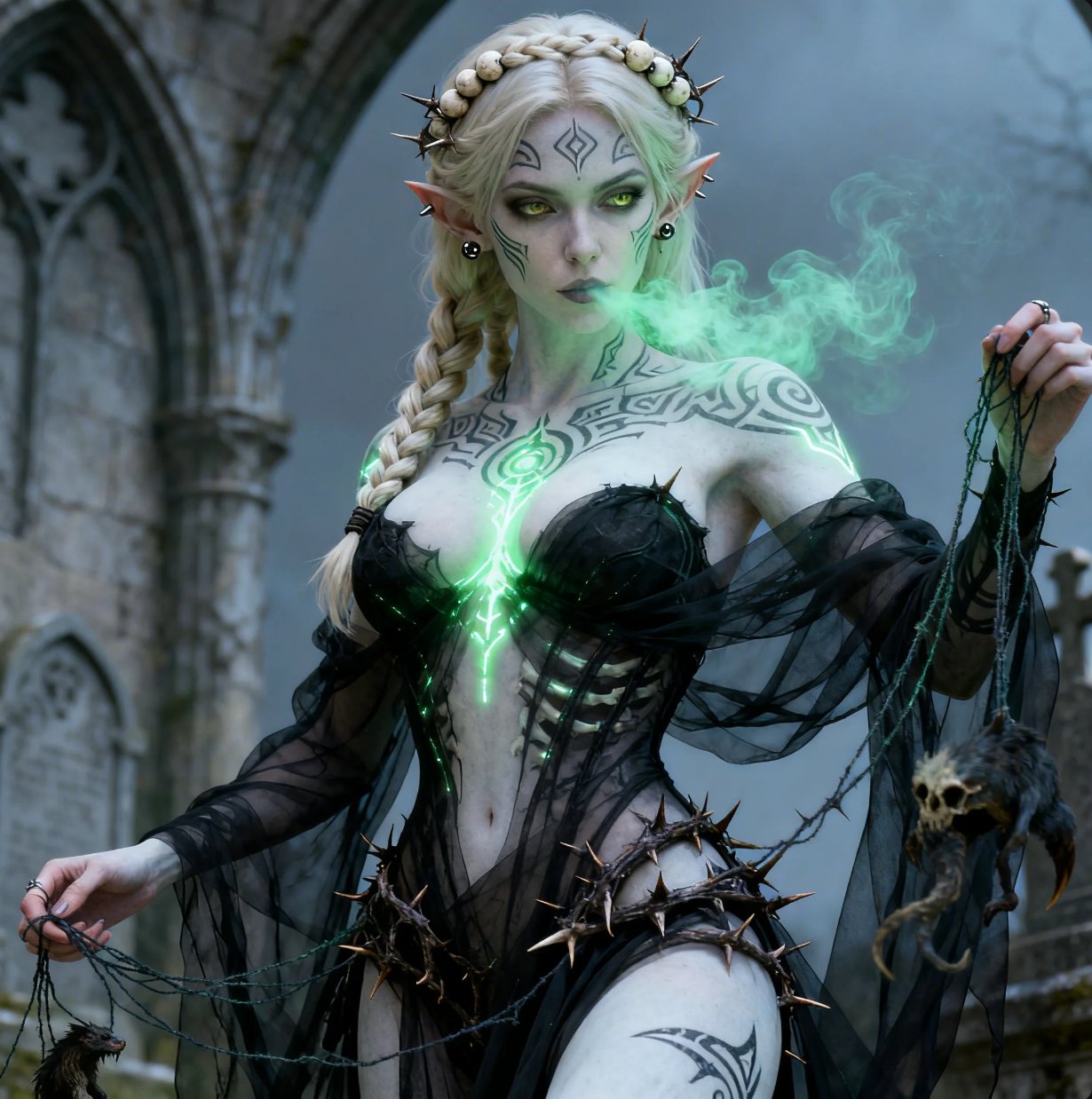
Feral clans dwelling in Necro-Catacombs: underground networks of graveyards fused with derelict bunkers, extending into sewer megastructures lit by phosphorescent fungi and flickering holo-screens.
Wasteland tribes offer ritual blood in bone-altars; savage vitae ferments into raw, corrupting mana. Bio-mechanical bat/wolf hybrid drones. They revere decay and rebirth — and clash with Red over urban encroachment.

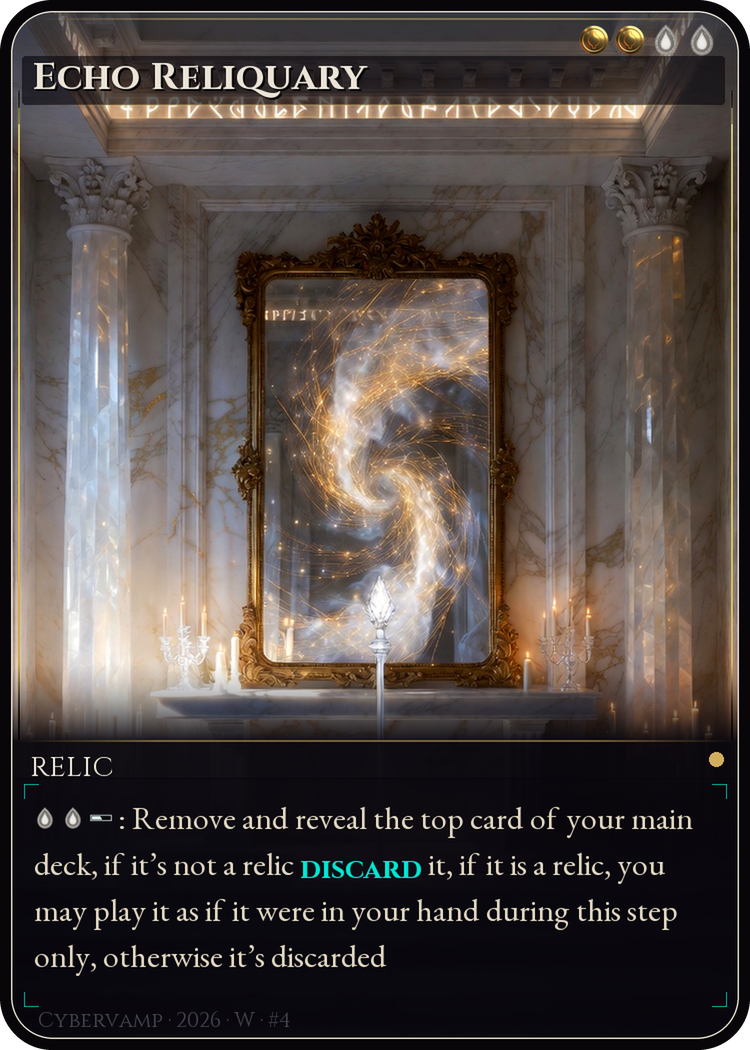
Exhaust: Remove and reveal the top card of your library. If it is not a Relic, place it in the discard pile immediately. If it is a Relic, you may play it as if it were in your hand. If you do not play it by the end of the turn, it is discarded.
The first glimpse of Cybervamp's card design — baroque architecture meets quantum circuitry, gothic runes framing the art of a Palace mirror with golden spiral technae energy. More prototype reveals coming soon.
Four legendary vampires who shaped the post-Eclipse world. Each feels your unseen Will as compulsion, technae surge, and synchronicity.
The oldest surviving bloodline patriarch — turned as Vlad III Tepes in the pre-Eclipse era — Vladislav amassed relics and genome codes before the war. During the Crystal Ascension of 2152, he rallied fragmented noble houses, decreeing the "Purity Edicts" and forging the Veiled Accord's core. He presides over the Gilded Conclave with regal poise, viewing humans as cherished vassals. Aristocratic, eloquent, coldly calculating. Dissenters are exiled to the void without ceremony.
A former human tech mogul who self-turned via experimental synth-bite prototypes mid-battle during the Eclipse War. In the Neon Ignition of 2155, he live-streamed his protocols and viral-marketed eternal upgrades to disillusioned zoomers. Charismatic, blunt, meme-loving — inspires fanatical loyalty but burns out followers. His public feuds with Vladislav over genome-hoarding are legendary. His impulsive whims cause volatility that ripples across the entire faction.
An ancient scholar-vampire who blended mysticism with quantum tech during the Eclipse War — using clairvoyant algorithms to predict AI strikes and evacuate knowledge-hoarders to anti-grav platforms. The Aether Awakening of 2153 unveiled his Mystic Algorithms. Warm, eccentric, infinitely patient. Haunted by a lost protégé sacrificed to technae overload — a wound that never fully healed. He orchestrates events from shadows for long-term harmony.
Once a rogue bio-engineer obsessed with conquering death through necro-nanites, Elias turned himself in a catastrophic lab accident that fused his mind with his creations. Emerging feral from irradiated bunkers, he wandered wastelands binding mutated wolves and bats via ritual siphons. The Necro-Pact of 2150 formalized his hive. Gaunt, scarred, robed in bio-mechanical fabric. Speaks in scientific jargon laced with dark poetry. Tormented by early "monstrous" failures.
Four vampire factions battle for dominance over an eternal night city. You are a faction lord. These are your laws.
Four vampire factions battle for dominance over an eternal night city. You are a faction lord — summoning creatures, playing spells, and deploying relics — all with one goal: reduce your opponent's life to zero.
Starting life: Both players begin with 20 life. Life has no upper limit — you may gain life beyond 20.
You win when your opponent reaches 0 life. You lose when your own life reaches 0 — loss is immediate at any point during the game, regardless of phase.
Draw: If both players reach 0 simultaneously — from the same Bleed resolution or mutual combat — the game is a draw.
You bring two separate shuffled decks to every game:
Main Deck — minimum 40 cards. Contains creatures, spells, and relics.
Land Deck — minimum 20 cards. Contains only land cards.
| Card Type | Copy Limit |
|---|---|
| Core cards | No limit |
| All other cards | Maximum 3 copies per deck |
| Unique cards | Maximum 1 copy in deck; only 1 in play on your side at any time |
| Token cards | Cannot be included in decks |
Shuffle your Main Deck and Land Deck separately. Each player draws 7 cards — you may draw from either deck in any combination. Decide who goes first by coin flip or mutual agreement. The player going first does not draw a card on their first turn.
Every card in play is always in one of three states:
| State | Position | Effect |
|---|---|---|
| Renewed | Upright | Ready to act. Default state at start of each turn. Ongoing abilities are active. |
| Exhausted | Rotated 90° | Card has been used. Cannot act again until it renews. Ongoing abilities are inactive. |
| Overexhausted | Rotated 180° | Powerful special ability — can only activate from Renewed state. Takes two full Renew phases to return to Renewed (first to Exhausted, then Renewed). Ongoing abilities are inactive. |
{R} Red Blood
{W} White Blood
{P} Purple Blood
{B} Black Blood
{G} Gold
{C} ColorlessBlood is the colored resource used to play cards and activate abilities. Each faction produces its own color: Red, White, Black, or Purple. Colored Blood can also be spent to pay generic colorless costs.
Gold is a separate colorless resource produced by Gold lands. It appears in the playing cost of most creatures and relics alongside Blood. Gold can substitute for any generic colorless cost — but it cannot pay for colored Blood requirements, and colored Blood cannot substitute for Gold.
Every card that has a cost shows it in the top-right corner as a row of icons. To play the card, you must spend exactly those resources from your lands.
Each colored blood drop icon represents 1 Blood of that faction's color. The Gold coin icon represents 1 Gold. You pay costs by exhausting your lands — each land produces 1 resource when exhausted.
Lands are your resource base. You may only play 1 land per turn, during your own Pre-Battle or Post-Battle phase. Lands have no playing cost — they are placed in play directly from your hand. Lands enter play in a Renewed state and are not subject to Newly Turned.
Each turn has five phases, always in this order. Master the eternal rhythm of the hunt.
| Phase | Key Actions |
|---|---|
| 1 — Renew | Exhausted → Renewed. Overexhausted → Exhausted. |
| 2 — Draw | Draw 1 card from Main or Land deck. Skip if empty. |
| 3 — Pre-Battle | Play land, play cards, activate abilities. |
| 4 — Battle | Declare attackers → respond → declare blockers → respond → resolve damage. |
| 5 — Post-Battle | Play cards, activate abilities. Then: take Bleed damage, remove Bleed counters, end-of-turn effects. |
Spells can be played during any phase of any player's turn except the Renew phase. All spells resolve immediately when played — there is no waiting. However, both players have a window to respond before resolution occurs. Spells are placed in your Discard Pile after they resolve.
Whenever a spell is played or an ability is activated, both players have a chance to respond before it resolves. Responses are resolved in Last In, First Out (LIFO) order — the most recently played response resolves first.
This creates a response chain. Either player may continue adding responses until both players pass without adding anything new. The chain then resolves from the top down.
Land plays do not use the response system. A land entering play cannot be responded to.
If a spell or ability targets a specific card or player and that target is no longer valid when the spell resolves — for example, the targeted creature was destroyed by a response — the spell fizzles. It has no effect and is placed in the Discard Pile.
Activated abilities on cards (such as Exhaust abilities or Overexhaust abilities) can be responded to in the same way as spells. Triggered abilities — those that say "when" or "whenever" — also go through the response system and can be responded to before they resolve.
| Card Type | When It Can Be Played |
|---|---|
| Creatures, Relics, Lands | Only during your own Pre-Battle or Post-Battle phase. |
| Spells | During any phase of any player's turn, except the Renew phase. All spells resolve immediately and can be responded to. |
During your Battle phase, choose any number of your Renewed creatures to attack. Newly Turned creatures cannot attack unless they have Haste. Attacking exhausts each attacker unless it has Tireless.
Response window: After attackers are declared, both players may play spells or activate abilities before blockers are declared.
Your opponent may block using any of their Renewed creatures. Each blocker is assigned to exactly one attacker. A creature with a multi-block ability may block more than one attacker — the blocking player chooses the assignments.
Response window: After blockers are declared, both players may play spells or activate abilities before damage resolves.
Once both players pass on the final response window, all damage is dealt simultaneously. Unblocked attackers deal their full power as damage directly to the defending player. Blocked attackers deal their power to their blocker; the blocker deals its power back to the attacker.
| Situation | Result |
|---|---|
| Attacker power > Blocker power | Blocker is destroyed. If the attacker has Breach, excess damage hits the defending player. |
| Blocker power > Attacker power | Attacker is destroyed. Excess damage does not carry back to the attacking player. |
| Equal power | Both creatures are destroyed. |
All destruction is simultaneous. Triggered abilities that fire on destruction all trigger at the same time and are then resolved through the response system in LIFO order. Destroyed creatures are placed in their owner's Discard Pile unless an effect specifies otherwise.
When a creature with Bleed X deals combat damage directly to a player (unblocked hit or Breach overflow), that player gains X Bleed counters. At the end of your own Post-Battle phase, you take damage equal to your total Bleed counters, then all counters are removed.
If a creature would apply Bleed to a player who already has Bleed counters, the new counters are simply added to the existing total.
If a creature has Bleed 1 applied to it twice — through abilities or effects — it has Bleed 2. Multiple instances of Bleed on the same creature are combined into a single value.
"Bleed represents a wound that festers — the full pain hits after the battle is over. Some cards benefit from having Bleed counters, so managing them is part of the strategy."
Unique cards represent legendary, one-of-a-kind vampires and relics. Only 1 copy of a Unique card may be in play on your side at any time. Both players may control a copy of the same Unique card simultaneously — one on each side.
If you would ever control two copies of the same Unique card — due to a spell, ability, or other effect — the copy you controlled before the new one is immediately destroyed.
Relics are permanent cards that remain in play once played. Unlike creatures they cannot attack or block, but they provide ongoing passive effects or activated abilities. Relics enter play in a Renewed state and are not subject to Newly Turned. Relics remain in play until destroyed by a card effect.
Tokens are created by card effects during the game. They are treated as creatures in all respects — they can attack, block, and be targeted by spells and abilities. They cannot be included in decks. There is no limit to how many tokens of the same type can be in play at once. If a token leaves play for any reason, it is removed from the game entirely rather than going to the Discard Pile.
You own every card that came from your decks. You control any card currently in play on your side, including cards you gained from your opponent.
If a card you control but do not own is destroyed, it goes to its owner's Discard Pile — not yours. If you lose control of a card, it moves to the appropriate zone under its owner's control.
Any ability that says "when this enters play" triggers whenever that card enters play by any means — played from hand, returned from the Discard Pile via Reanimate, created as a token, or put in play by any other effect. There are no exceptions unless a card specifically states one.
Each player has their own Discard Pile — a face-up pile kept beside their Main Deck. Destroyed creatures, resolved spells, and any card sent from play are placed here. Cards in the Discard Pile are not in play and cannot be used unless a card effect specifically allows it — such as Reanimate, which allows a creature to be played directly from it.
Newly Turned applies to all creatures the turn they enter play. A Newly Turned creature cannot attack or activate abilities until the start of your next Renew phase. Creatures with Haste ignore Newly Turned entirely. Lands and relics are never subject to Newly Turned.
A card's ongoing abilities are not active while it is Exhausted or Overexhausted. Only cards in a Renewed state have their ongoing abilities in effect.
If the deck you choose to draw from is empty, you simply skip the draw. There is no penalty for an empty deck — the game continues normally.
The powers of the Crimson Nexus — every keyword that governs its vampiric laws.
The Veiled Accord is strong — but it is not unbreakable.
Click any card to view full size. Filter by faction.


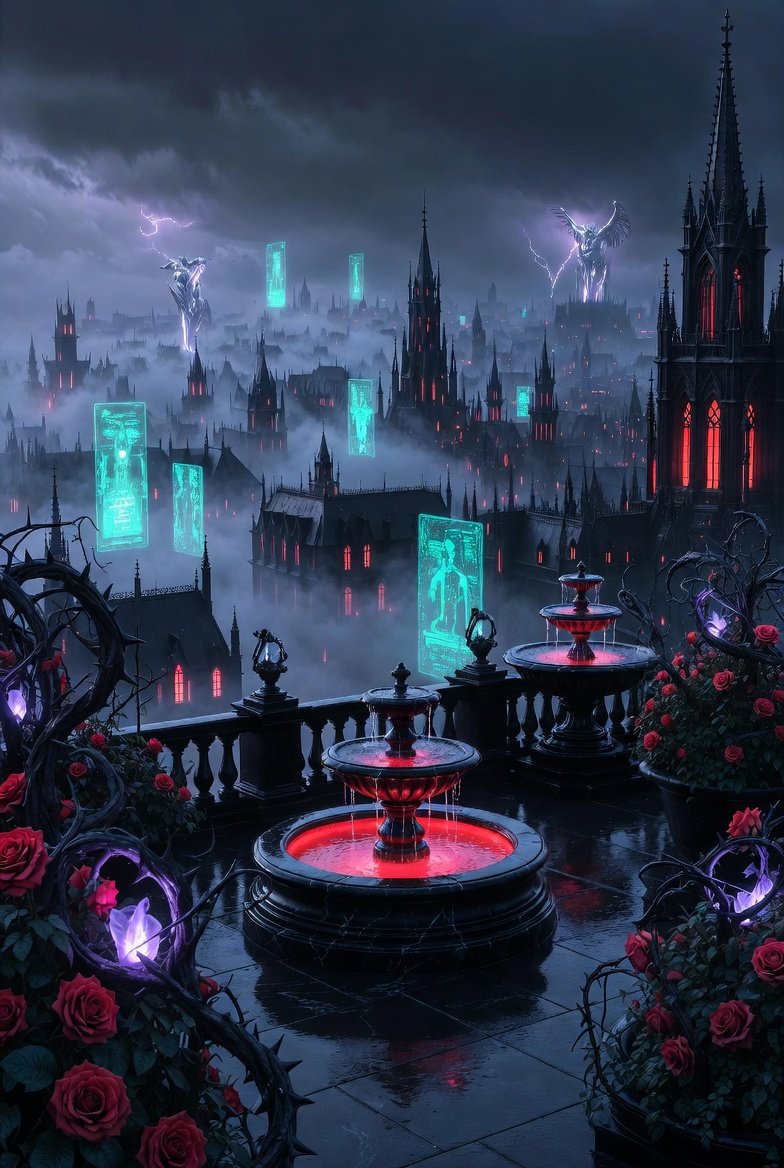
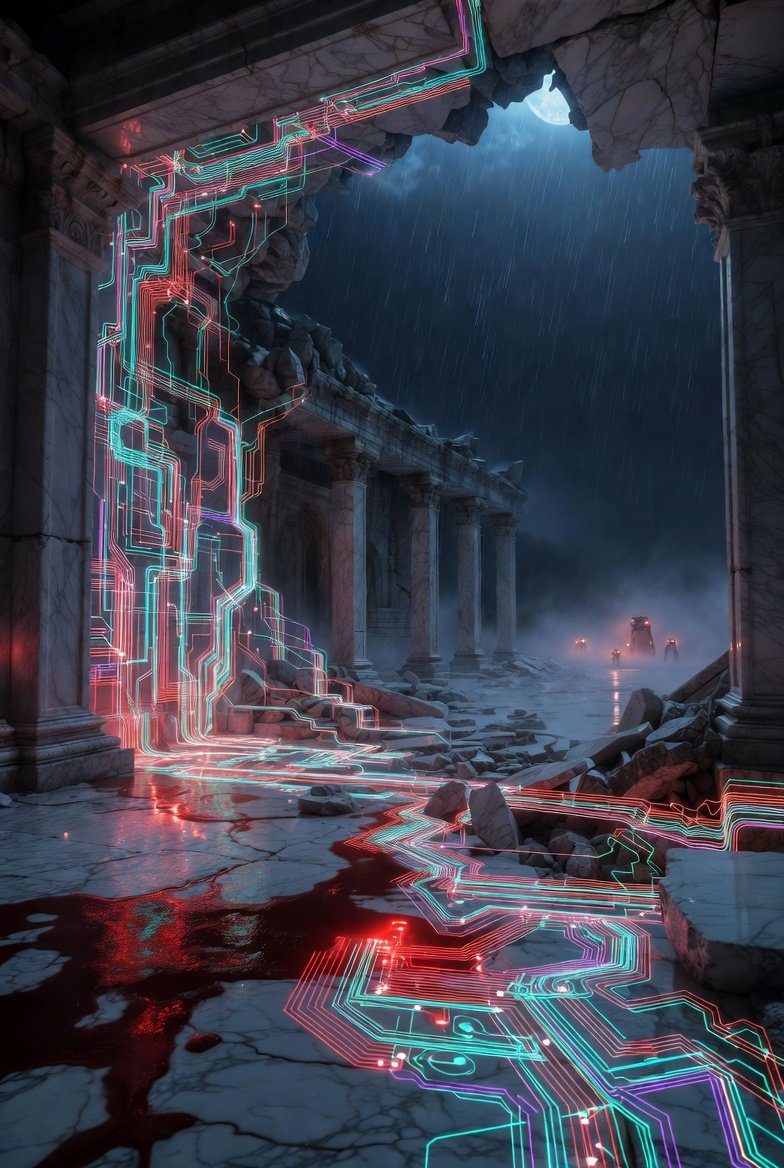
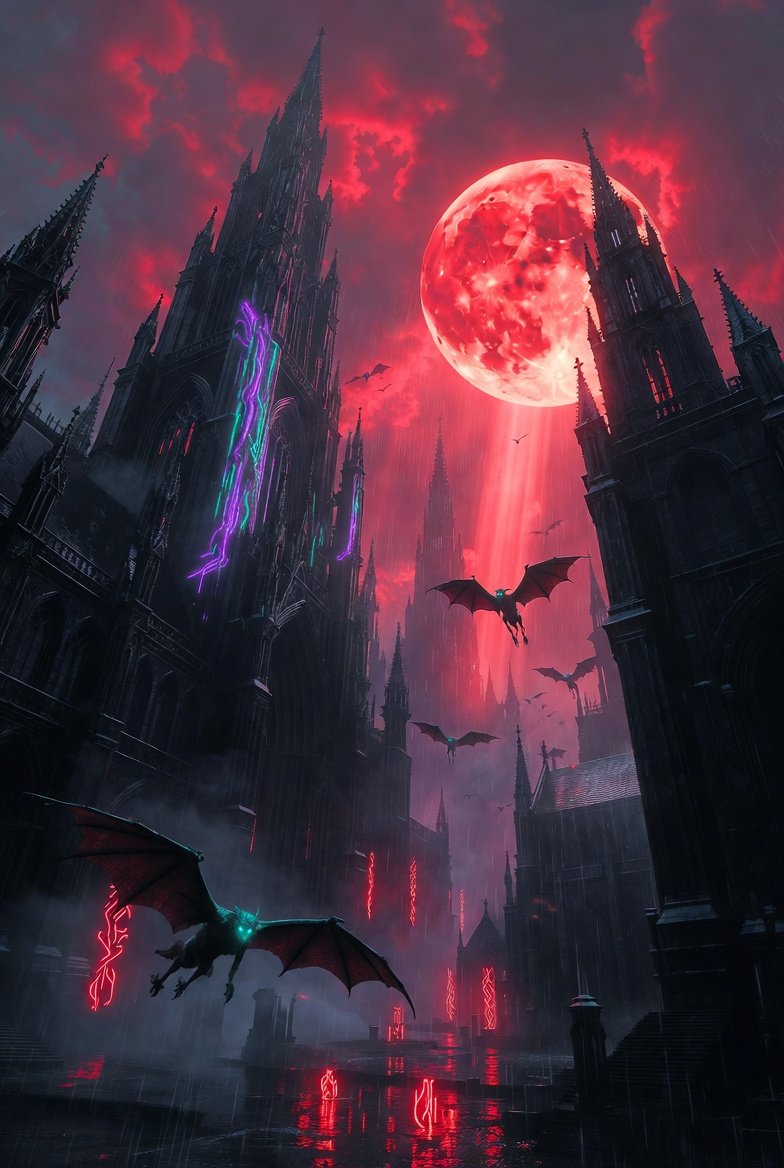
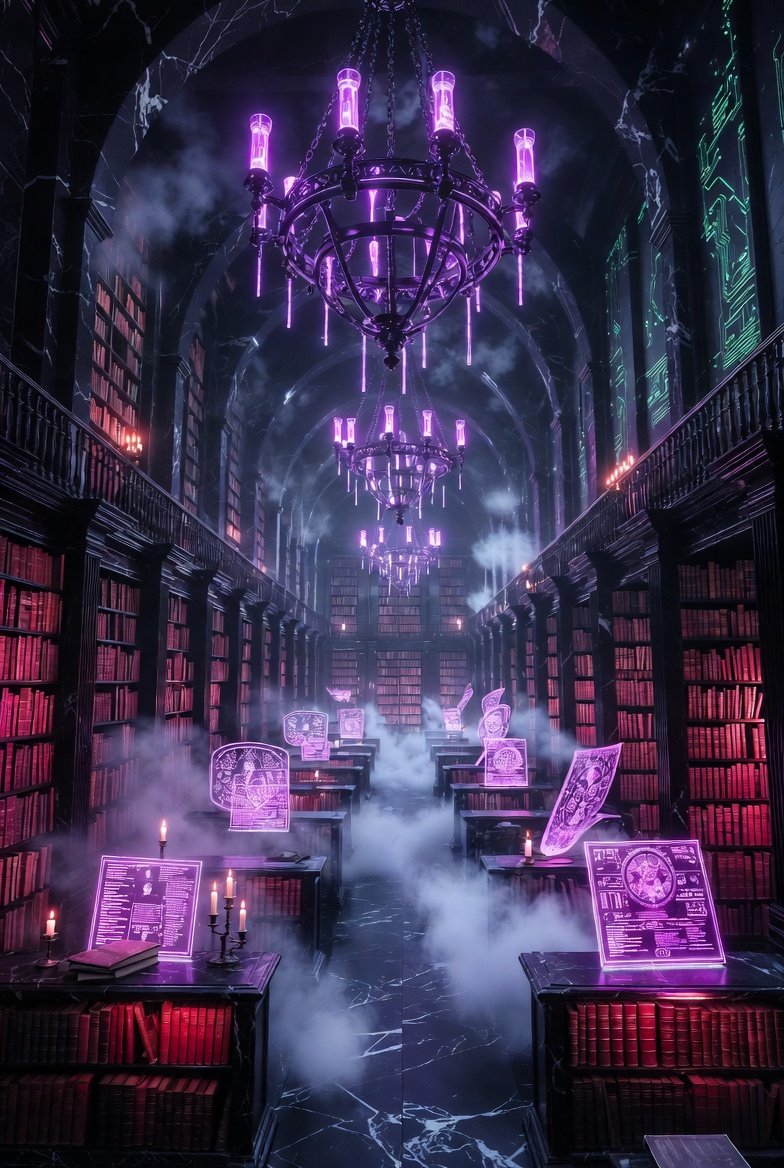
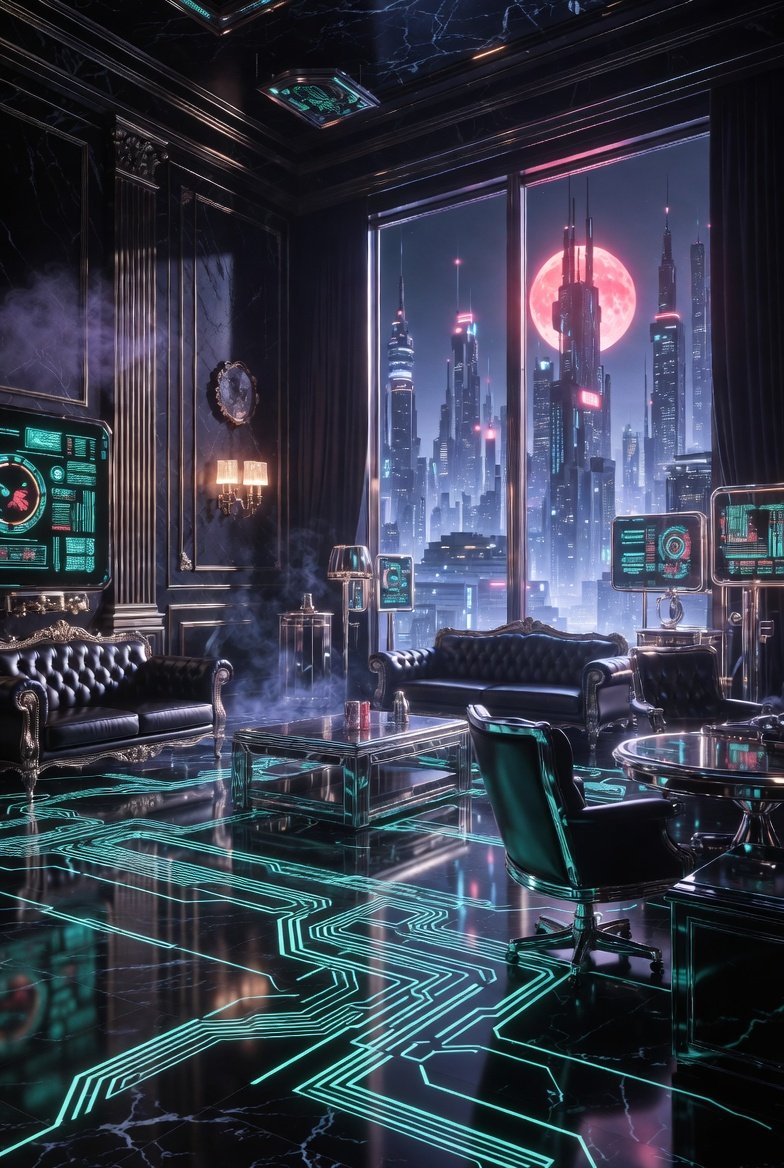
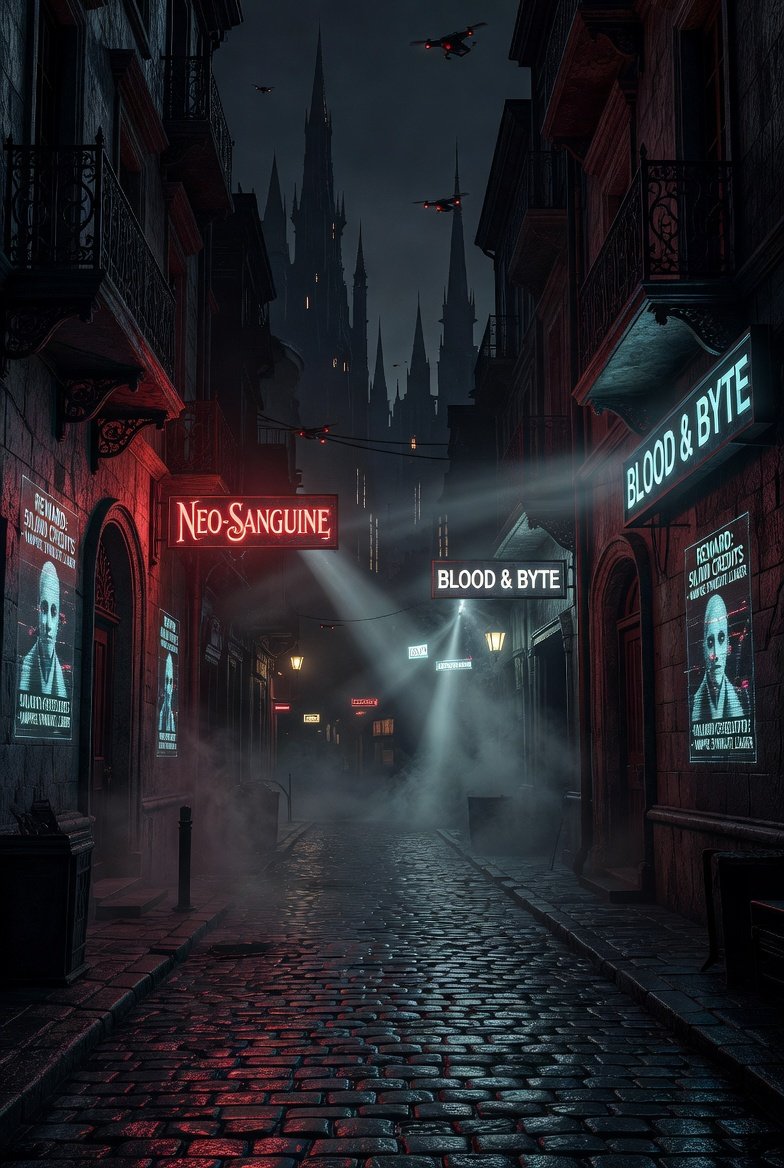
Gothic architecture meets neon circuitry. Blood fountains beside quantum databanks. The eternal night hums with technae.